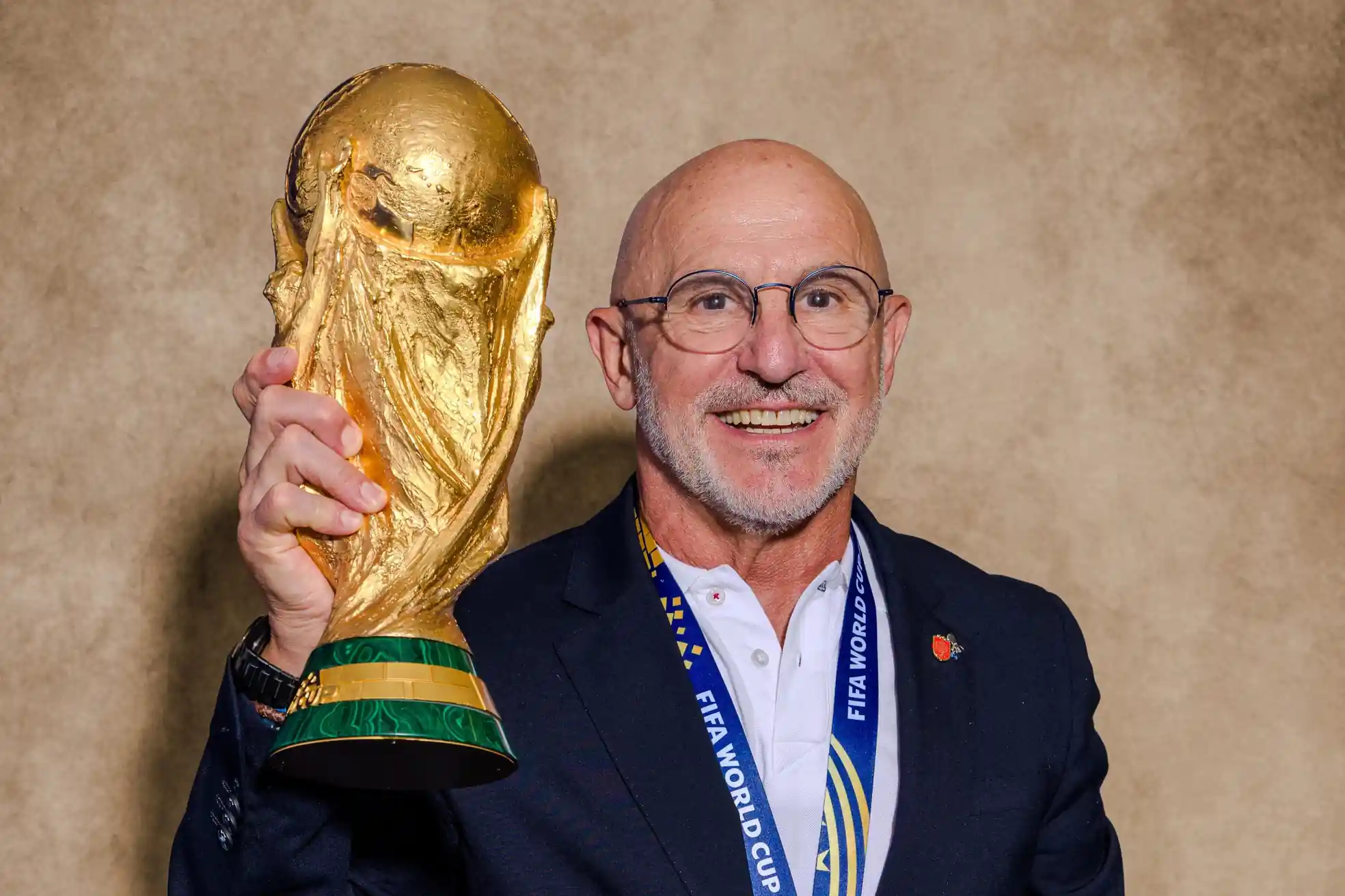
De la Fuente: Spain stayed true to our principles
Spain coach discusses World Cup 2026 triumph with FIFA
De la Fuente reflects on what was achieved, and how Spain managed to do it
Coach says Spain stayed true to the football they wanted to play
It is a match, and a date - 19 July 2026 - that will forever be remembered as one of the greatest in the nation's football history. Spain’s victory over Argentina in the final of the FIFA World Cup 2026™ added to the title they lifted in 2010. Under Luis de la Fuente, La Roja completed a tournament in which they conceded just once before lifting the trophy, having seen off the likes of Portugal, France and Argentina.
In an exclusive interview with FIFA, De la Fuente looks back on Spain’s journey from the start of qualifying on 4 September 2025 to glory at New York New Jersey Stadium.
FIFA: What has been going through your mind in the weeks since winning the FIFA World Cup 2026?
Luis de la Fuente: It’s difficult to take in everything we’ve been through. You try to process it, but I think only time will give us a true sense of the scale of what we’ve achieved. We know what we’ve been through and, more than anything, how we went through it. That makes us very happy and very proud, and it helps us understand that we’ve achieved something historic.
Your qualifying campaign began on 4 September 2025. Mentally, how did you set about going all the way?
We always focus first and foremost on what we can control: doing our job well, staying true to our principles and our model, and knowing that the closer we are to that idea, the closer we’ll be to winning. That said, we also know how hard it is to win.
I kept saying it was a historic World Cup. Beyond the obvious fact that there were 48 teams, it was also the tournament with the strongest field of genuine contenders. In my view, six, seven or eight teams were capable of winning it, which made an already difficult challenge even tougher.
We always tried to stay true to our principles while raising our level. I believe the key to our success was the process of turning a national team into the best team in the world. I really mean that too: the best team in the world.
It started with a 0-0 draw against Cabo Verde. Was the team affected by that result?
We wanted to win every match, while knowing how difficult it is to begin a World Cup. We knew Cabo Verde’s strengths: they were very disciplined defensively and physically very strong. They performed very well. In that opening match, as was only natural, we didn’t quite have the sharpness needed to break down a team defending like that. It reminded us how difficult the tournament would be and how important it was to be at our best every time. It had no negative effect; if anything, it strengthened our conviction that we had to keep doing things our way.
You won the title while conceding only once, getting past a Portugal side with a top-class midfield, containing a France team with huge attacking quality and neutralising Argentina…
I’ve already emphasised the word team. We always spoke about each opponent’s particular strengths because they were all different. But one very important thing was to make the players feel that, although we were facing great national teams, those teams were coming up against the best side of all. That concept gave us a lot of confidence and strength.
That word we used -'family', came from the heart. The players felt part of something bigger than football. There was something more binding us together. Alongside the footballing talent, that’s one of this group’s great strengths.
Against Portugal and Belgium you won it late, and against Argentina in extra time, yet there was always a sense that Spain had the game under control.
In our post-match analysis, and after every game, we felt the matches had been under control, while fully recognising the problems each opponent posed. There was no opponent about who you could say: “They were better than us.” As a coach I greatly admire, Vicente del Bosque, used to say: “The game was played the way Spain wanted it to be played.” Every time. And that's true. We knew how hard it is to win a World Cup match. We deserved to win all of them by more comfortable margins, but we were facing the best in the world. The results and the process were almost exactly as we’d planned them.
Did you have time to reflect on what reaching the World Cup final meant, after so many years in the national-team set-up and with players you had known for so long?
It was like the perfect film script. I’d spent more than a decade with, above all, the 1996 and 1997 generations: winning the European U-19 Championship, the European U-21 Championship, Olympic silver, and everything we’ve won with the senior team with that same group.
Others came in along the way too, but they were players I’d also spent time with, especially in the U-21 side. When you reach the end of that first journey, you feel proud to have watched these boys grow. I met them when they were 16, and today they’re at the very top of world football. To have made that journey together is special. It’s really about people; it goes beyond the purely professional.
How did you approach the final against Argentina? It came with so many layers: playing for the World Cup, facing the reigning champions, trying to impose Spain’s identity...
We were very clear about the role we had to play in that final. We couldn’t move away from our own idea. Anything that took us closer to Argentina’s style of football, or to the kind of football Uruguay had played previously, would have taken us further away from our chances of winning.
The players showed extraordinary professionalism, responsibility, calm and composure, and never got dragged into the opposition’s game. We were always ourselves. The scoreline could have been more comfortable because we had chances to go two or three goals ahead. That would certainly have made it a different match, but even so, it reinforced our footballing convictions.
We were brought up, and this generation of footballers has been brought up, to work, to suffer, to understand that nothing comes easily and that you have to stay focused right to the end. Even with Argentina down to ten men, one lapse from us at a free-kick could have allowed them to equalise. That made the satisfaction of achieving the result through hard work and suffering even greater.
Nico Williams provided the assist and Ferran Torres scored the goal. Nico had been managed carefully because of fitness issues, while Ferran had not scored until then. Does that reflect those ideas of 'film script and 'family?'
Exactly. That underlines something we try to reinforce in every camp: all 26 players are important. We’ve got data showing that players coming on to replace their team-mates have helped decide more than 70% of our matches.
Whether you start or come on in the 80th minute isn’t the key thing. If you can be even more decisive in the 80th minute, as we’ve seen at the World Cup and the EURO, then that’s what matters. And that’s the value this group gives to the word team. Everyone is important. One of our strengths is humility: accepting your role and keeping egos positive. The collective good naturally comes before individual interest. But that only happens because we’ve built a group grounded in those values.
Recently, Lionel Messi announced his retirement from the Argentina national team. Does that add even more value to that already historic win?
I’m an admirer of Messi, of course. He’ll leave a footballing legacy that, like our title, will only grow in value with time. We’ll come to appreciate our World Cup even more, and we’ll appreciate even more what Messi has meant to football.
Having the chance to play a World Cup final against Messi and that constellation of Argentina stars obviously adds enormous value to what we achieved. In time, we’ll also understand even more clearly the way in which we did it.